Juliane Rebentisch – The Crisis of the Sublime
Lecture
Juliane Rebentisch – The Crisis of the Sublime
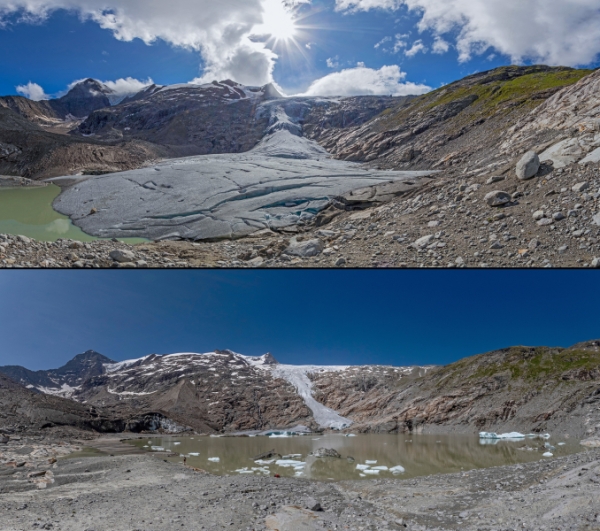
In view of recent environmental crises, the concept of the sublime seems to be relevant in two respects. These two respects correspond to the two sides of the sublime in Kant: the dynamically sublime on the one hand, and the mathematically sublime on the other. In view of the uncontrollable violence of extreme weather events, the association of the sublime with an overpowering might, as characterized by the dynamically sublime, seems obvious. Given that in the Anthropocene, environments tend to exceed human comprehension in their spatial and temporal extent, the association with an immeasurable magnitude characteristic of the mathematically sublime suggests itself as well. One might even think that the sublime is potentiated in a “hyperobject” (Timothy Morton) such as global warming, since it can be characterized by features both of the mathematically and the dynamically sublime. At the same time, however, such an “object” undermines central building blocks of the classical theories of the sublime. The crisis of the sublime is evident, among other things, in the fact that a related aesthetic phenomenon is increasingly making itself felt in the realm of the sublime: the uncanny.
Juliane Rebentisch is a professor of philosophy at the Hochschule für bildende Künste Hamburg. She is a regular visiting professor at the German Department of Princeton University and a permanent fellow at the Frankfurt Institute for Social Research. From 2015 to 2018, she was president of the German Society for Aesthetics. Publications include: Theories of Contemporary Art: An Introduction (Hamburg: Junius 2013); The Dispute over Plurality: Debates with Hannah Arendt (Berlin: Suhrkamp 2022), The Ecological Uncanny (Materialverlag HFBK Hamburg 2024).
With welcome remarks by Peter Geimer and an introduction by Franziska Solte.
The event is part of the bi-annual theme “Nature” of DFK Paris, led by Peter Geimer and Pierre Wat.
Associated Person